
Scientific papers are written in a structured format to outline research conducted to answer specific questions across all manner of scientific endeavour. The research methodology, analysis, results, discussion and conclusions or answers are explained and available in the research paper for the scientific community and the general public through hard-copy journals and on-line research sites. The “why” of the research is addressed but the backstory of the “how” often goes unmentioned.
With these scientific paper posts, the papers, all of which CWR researchers Curt and Micheline have been involved, the more personal backstory of how the research was undertaken will be told.
The Reference
J. Noad, D.H Cato, M. M. Bryden, M.-N. Jennerand K. C. S. Jenner (2000). Cultural revolution in whale songs. NatureVolume 408, Page 537.
The Title
Cultural revolution in whale songs
Humpbacks have picked up a catchy tune sung by immigrants from a distant ocean.
The Abstract
The song patterns of humpback whales (Megaptera novaeangliae) depend on where they live, with populations inhabiting different ocean basins normally singing quite distinct songs. Here we record a unique and radical song change in the song of humpback whales in the Pacific Ocean off the Australian east coast. Their song was replaced rapidly and completely by the song of the Australian west coast population from the Indian Ocean, apparently as a result of the introduction of only a small number of ‘foreign’ singers. Such a revolutionary change is unprecedented in animal cultural vocal traditions and suggests that novelty may stimulate change in humpback whale songs.
The On-line Link
https://www.nature.com/articles/35046199#citeas


The Back Story of the Research -It’s Got to Be You!
While surveying for humpback whales on the humpback highway in our small inflatable boat offshore from Enderby Island in the Dampier Archipelago, whenever Curt and I noticed an animal that was swimming solo or stayed down for more than 20 minutes, we had hunch it was a singer. Humpback male whales sing on the breeding grounds to attract the attention of female whales. These songs, first described by Katy and Roger Payne back in the 1970’s, are the most complex songs of the animal kingdom. Humpback whale songs feature specific themes, phrases, sub-phrases and units, all produced in repetitive and even rhyming order.
On days when we sighted a singleton humpback whale, in the Kimberley, Ningaloo or even off Rottnest Island, we would slowly and quietly approach the last seen footprint (or fluke print) in our small inflatable boat, cut the engine and slip our hydrophone over the side of the boat. A hydrophone or underwater microphone at the end of a long cord plugged directly into a tape cassette recorder, became our ears in the sea! Turning up the volume of the tape-deck, we listened attentively, hanging our hopes for him on every squeak and moan. The cord was held tightly and very still, carefully perched slightly above the side of our rubber boat to prevent any rubbing sounds tainting the precious whale song recording.
Eagerly awaiting its next surfacing, we were ready with a camera to capture the photo-ID of the said-singer. We lived through every trill and groan envisaging him lying mid-water on a 45 degree-angle, head down and its pectoral fins out-stretched and gently holding position with small circular movements. His tail flukes held well higher than his head, remained motionless. For their harmonious efforts we variously named the singers Pavarotti, Neil Diamond and even Elton John. The tunes of others garnered different names, like Mr Motorbike or Froggie, for said similar tones. For some crooners we would even see their success. A blow of a whale on the humpback highway over there, is soon joined by a singer we had previously encountered 2 nm away. Will they get together? Will his song be good enough? So many questions. On several occasions we observed singers attracting other adults and indeed continue traveling together. How long would their courtship last? Apparently, at most 2 hours or 2 days. Not a long, but effective union.
Eagerly awaiting its next surfacing, we could hear when he sang the creaky door sounds, this indicated he was coming up for air. With a huge whoosh of air rapidly escaping its lungs and billowing skyward from its two widely expanded nares or nostrils, we would be mildly alarmed but quickly gain composure and collect photo-ID of said-singer. Its unique left or right lateral flanks including both sides of the dorsal fin and their “finger-print-like” flukes as it dived back down to continue serenading any passing females.
With a song in the can and a photo-ID on the film (yes, we were still using slide film transparencies in those days!), we would bid our fair singer adieu and wish him success with his singing sessions.
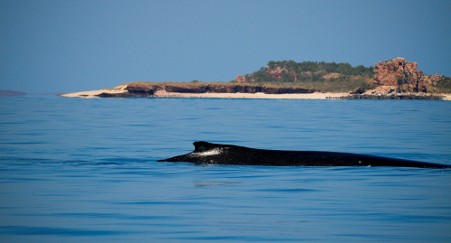
In the calm waters of Lalang-garram/Camden Sound Marine Park, a humpback whale surfaces between singing sessions. Photo: M. Jenner AM
An enquiry came in the late 90’s requesting if we would be interested in sharing our collection of WA humpback whale song recordings with an east coast song researcher. In the spirit of collaboration, we didn’t hesitate and dutifully packed a box of tape cassettes labelled by year and individual song recordings denoted by a pair of counter numbers from the tape-deck indicating the beginning and end of each whale’s song. Yep, old school, but this was how it was done then!
Prof Mike Noad analysed the WA recordings collected from the Dampier Archipelago, the Kimberely and even from near Rottnest Island and compared them with east Australian recordings and made some incredible findings. Remarkably, in the 1996 east coast whale season recordings, 2% of humpback whales were singing a new tune, WA’s more simple song. The very next year, Mike determined that 94% of the east humpback whale songs collected were also singing the western jingle! By 1998, 33% of the singing east coast humpback whale males were still belting out the WA’s Top 40!
Due to the rapid change (over 2-3 years) and significant adaptation of a new song by a population from a different coastal region was deemed a cultural revolution rather than a slower evolution. This caused quite a buzz and garnered a coveted Nature publication!
All those hours listening to the melodies of the sea brought interesting understanding and made all the small boat bouncing worth it!
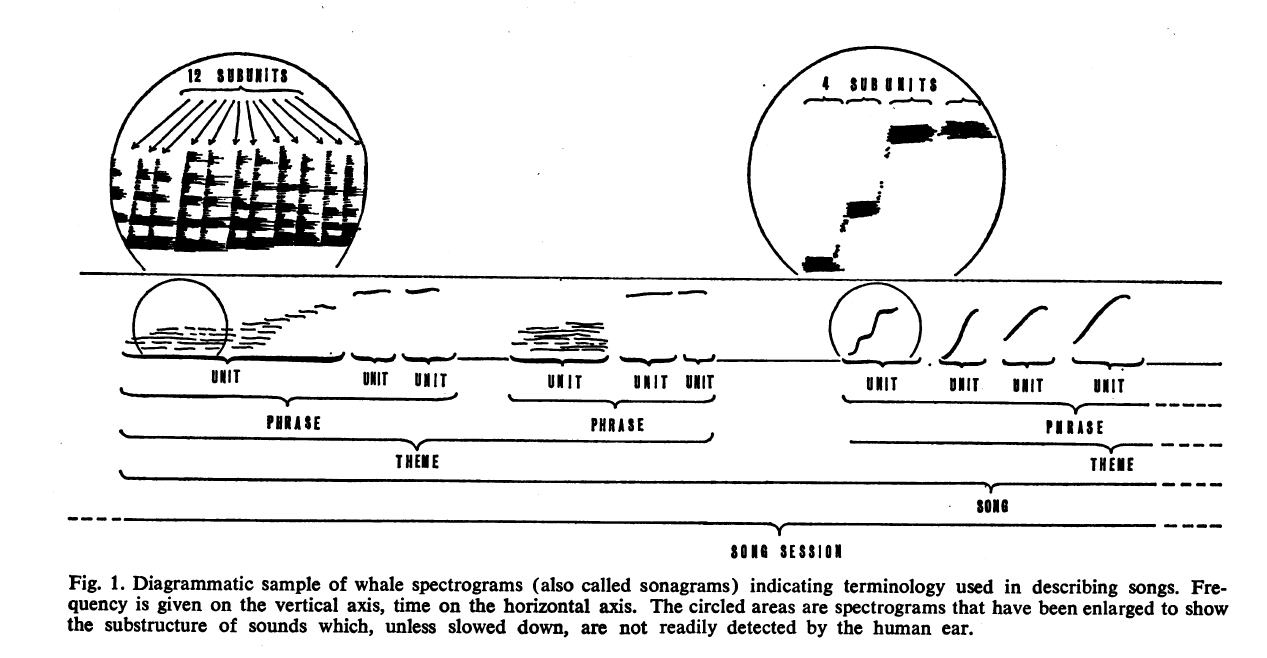
Graphic of a humpback song on a sonogram from the scientific paper Payne & McVay (1971).
Our mid-90’s CWR research hailed from the knowledge shown in this image of a sonogram of humpback song featured in a scientific paper Payne & McVay (1971). In this research paper, humpback whale calls were first described as complex repeating songs. Following this revelation, many scientists, including ourselves, dedicated countless hours to small boat work and sonogram identification.
No comments yet.