
(Written by Micheline Jenner AM)
Scientific papers are written in a structured format to outline research conducted to answer specific questions across all manner of scientific endeavour. The research methodology, analysis, results, discussion and conclusions or answers are explained and available in the research paper for the scientific community and the general public through hard-copy journals and on-line research sites. The “why” of the research is addressed but the backstory of the “how” often goes unmentioned.
With these scientific paper posts, the papers, all of which CWR researchers Curt and Micheline have been involved, the more personal backstory of how the research was undertaken will be told.
The Reference
The Title
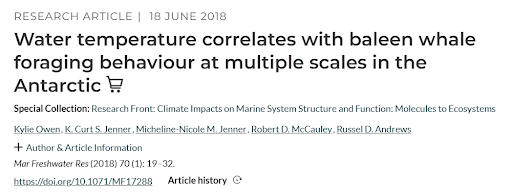
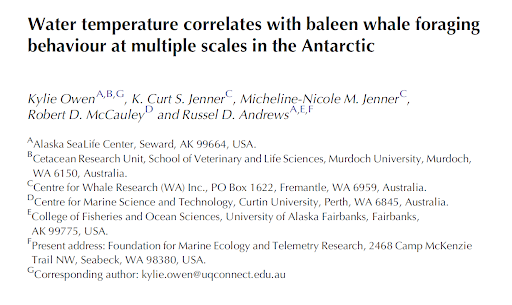
Water temperature correlates with baleen whale foraging behaviour at multiple scales in the Antarctic
The Abstract

The On-line Link
https://doi.org/10.1071/MF17288
 A 31-day WAVES (Whale Song Antarctic Voyage for Ecosystem Studies) voyage was undertaken from Hobart, Tasmania in Australia aboard RV Whale Song south to the soft ice-edge in East Antarctica during the 2013/2014 summer. A 9-day survey track along the soft ice-edge where feeding humpback whales were encountered provided excellent opportunities for collecting individual photo-ID, taking biopsy samples and the deployment of satellite telemetry devices on the flanks of 5 humpback whales.
Several streams of data were collected continuously aboard RV Whale Song en route, including cetacean and seabird visual sightings, sea surface temperature (SST) and real-time 6 hourly weather measurements for the Bureau of Meteorology (BOM). Acoustic detections, classified as Natural (earthquakes, iceberg grinding or glacier calving), Man-made (shipping and seismic surveys) or Biological (marine mammals or marine fish) were made and recorded using deployed sonobuoys provided by the Australian Department of Defence.
Figure 1 below displays key variables recorded during the voyage including sea surface temperature indicating that where the cooler water (below 00 C) shown in a). corresponds to where we observed and satellite-tagged whales.
Figure 2 below from this scientific paper shows the study area along the soft ice-edge in East Antarctica. As the legend below describes, the red line is RV Whale Song’s track line through-out the 9-day survey along the soft ice-edge looking for feeding humpback whales. The coloured squiggly lines represent the tracks of the satellite-tagged humpback whales, the blue and green lines of the first two humpback whales and the next three tagged humpback whales are purple, yellow and orange lines.
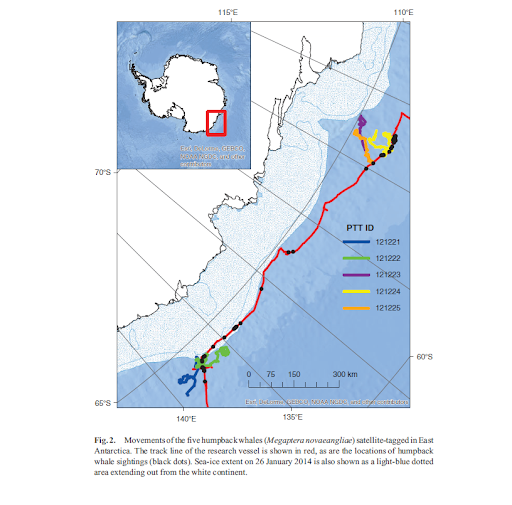 Figure 7 below shows data from the lunge rate from Whale Lander archival tag deployed on “Tiny Lander” was higher with cooler water.
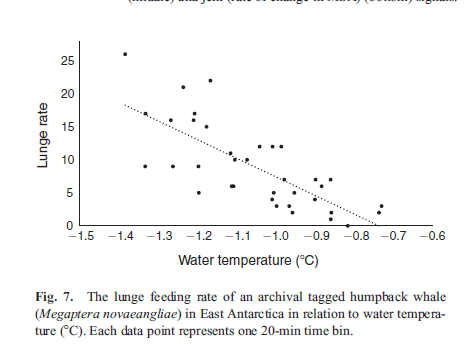 Interestingly, the humpback whales appeared to be using the warmer SST melt water to locate the krill (following conditions that the algae favour) across tens of kilometres but once amongst the krill swarms, the tagged humpback whales seemed to target that slightly cooler water for their feeding dives.
The consequences of climate change (warmer water, melting glaciers and less solid sea-ice) in Antarctic waters may be reflected by the health of humpback whale populations (indicated by overall body condition, cohort numbers and population size increase or decline) in the coming decades.
The Back Story of the Research – Warm and Cool Water Matters
While topping up RV Whale Song’s medical supplies at a pharmacy in urban Hobart, as the young man scanned the gathering pile of standard first aid products, he asked where we were going.
‘Oh, we’re heading down south’ I replied offhandedly. Many people we were chatting with in shops and market stalls had been “down south” to Antarctica multiple times, so I thought this was the accepted vernacular for such a journey.
His puzzled expression at my answer and his following question indicated he thought we were heading to the southern areas of Australia’s famed Apple Isle, not to the white continent at the bottom of the world!
‘Don’t they have chemists down there?’ he proffered, screwing his face up in disbelief.
We were reminded as we left the chemist with our potentially life-saving supplies for such a voyage, that we were, and would be totally self-reliant and this would be indeed an extraordinarily wild and beautiful experience.
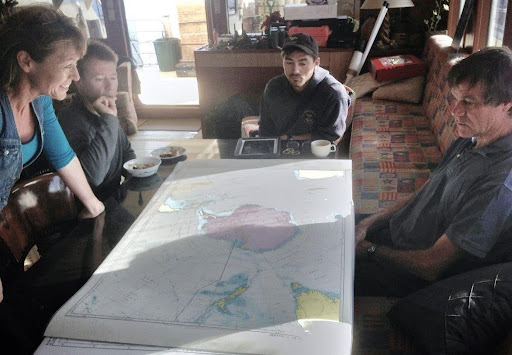 Checking the Chart. ‘Oh, that’s a long way, let’s get going!’ Photo: I. Ford
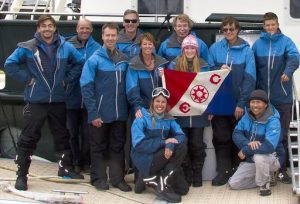 Meet the Crew. Dressed for success and filled with ambition, meet the intrepid crew of RV Whale Song. Photo: I. Ford
As RV Whale Song made her way down the Derwent River, our crew of 10 including Curt, Dale Peterson, Resty Adenir, Simon Kenion, Sam Wright, Inday Ford, Tasmin Jenner, Rob McCauley, Russ Andrews and myself, Micheline were excited and possibly a tad nervous regarding this expedition. Afterall, our vessel was only 28m long, though a small but well-prepared vessel – we were going to the Antarctic, anything could happen!
 Ready and Able. At long last we were ready, it was time to head south, real, real SOUTH! Photo: M. Jenner AM
Being my second time, I was overwhelmed with anticipation. My diary entry that evening read ‘I am so excited, I fear my soul will burst…’
The data forming the basis of this scientific paper relates to cetacean observations collected at three different scales, broad, medium and fine scales aboard RV Whale Song. Visual cetacean sighting surveys conducted by at least 2 personnel from the flybridge for at least 12 hours of each day comprise the broad scale data. Medium scale movement data came from the up to 2-week-long tracks of LIMPET (Low Impact Minimal Percutaneous Electronic Tag) satellite-tags deployed on feeding humpback whales. A Whale Lander Tag with a suction cup and prongs attached to a humpback whale for 13 hours before recovery, garnered fine scale movement information as the whale fed during through the evening and early hours of the morning in the productive cool south.
Having thought about this voyage for a few years, the planning really came together about 6 months before. An important part of our preparation was our:
Checklist for Success:
-Small ship – tick
-Small ice-class rated ship – tick
-Intrepid crew – tick
-Sponsorship from Eddie Bauer for our excellent polar crew clothing – tick
-Explorers Club Flag 69 for our WAVES Flag Expedition – tick
-Ship and research supplies coming out our ears – tick
-Food for 31 days, including: 34 baguettes, 34 chocolate bars, 50kg of protein, 5kg of fish, 30 loaves of wholegrain bread, 20kg of pinkeye potatoes and 40kg of rice – tick
-Cold water with icebergs – tick
-Cetacean sightings on the high seas – tick
-5 LIMPET tags – tick
-1 Whale Lander Tag – tick
-Krill swarms – tick
-Feeding humpback whales – tick
-5 Successful LIMPET tag deployments – tick
-1 successful Whale Lander Tag deployment and retrieval – tick
-Out of date sonobuoys from the Australian Department of Defence for listening to the sea – tick
-Safe passage to the ice, along the soft ice-edge and safe passage home – tick
Adventure and science – we were up for this!
 Speaking of Adventure and Science. Our WAVES (Whale Song Antarctic Voyage for Ecosystem Studies) was an Explorers Club Flag Expedition by Explorers Club Members Curt Jenner (FI’10) and Micheline Jenner (FI’10) carrying Flag 69. From left, Tasmin (14 years old), Micheline and Curt holding EC Flag 69 aloft. Photo: I. Ford
Heading south from Hobart, it was not long before we were amongst the icebergs and whales!
 Lone Male Sperm Whale. See you in an hour or so! Photo: M. Jenner AM
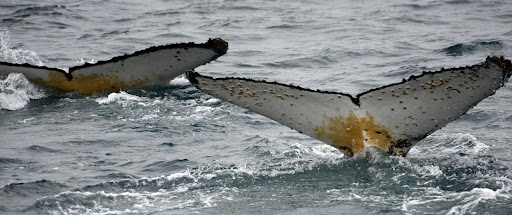 Fluke-Up! These two humpback whales have a few stories to tell! The whale on the right encountered a patch of tropical barnacle larvae that settled on the flukes while in warmer waters and indeed both animals are adorned with characteristic southern water Antarctic diatom mustard-orange algal smudges. Photo: M. Jenner AM
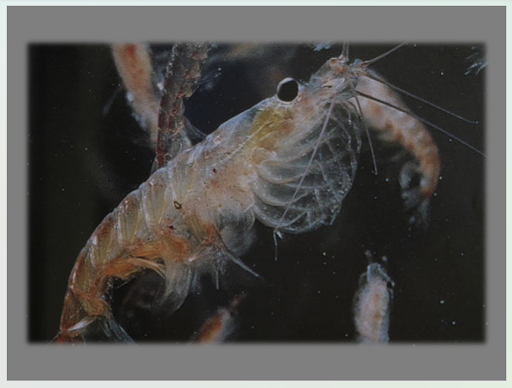
Krill’s Up! This is the keystone species of the Antarctic ecosystem. The seabirds, seals, dolphins and whales all feed on these finger-joint sized crustaceans.
From our Checklist for Success, Russ had brought 5 LIMPET tags. The LIMPET tag medium scale data collected across 10’s of kilometres indicated that the sat-tagged humpback whales sought slightly warmer cool water, being the meltwater where krill gather to feed on blooming algae. Humpback whales actively targeted this cool water where the key components-algae (phytoplankton) and krill (zooplankton) of the Antarctic system food chain congregate.
 Palm-sized. Less than the palm of your hand and weighing just 56g, the LIMPET tag (Low Impact Minimal Penetration Electronic Tag) lived up to its name, as they sat nice and flush on the whale’s bodies and showed the CWR Team how the whales were feeding. Photo: M. Jenner AM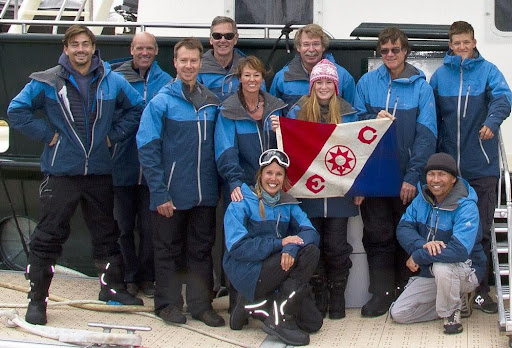
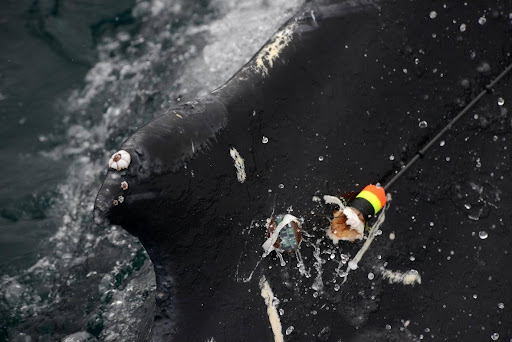 TAG ON! From RV Whale Song’s bow, Russ deployed a LIMPET tag with our Dan Inject rifle. The tag is on the whale (in the centre of the image,) and the arrow with the tag holder (coloured black, yellow and red) comes free from the tag on the whale and floats on the water surface for retrieval. Photo: M. Jenner AM
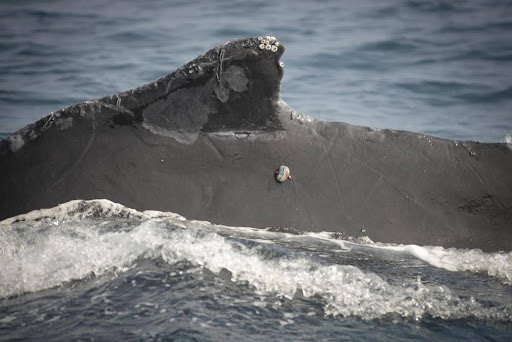 Barnacle Bill. This humpback whale has a cluster of barnacles on its dorsal fin hence its descriptive name but it is also adorned with a LIMPET Tag providing unique information about Barnacle Bill’s feeding movements. Photo; M. Jenner AM
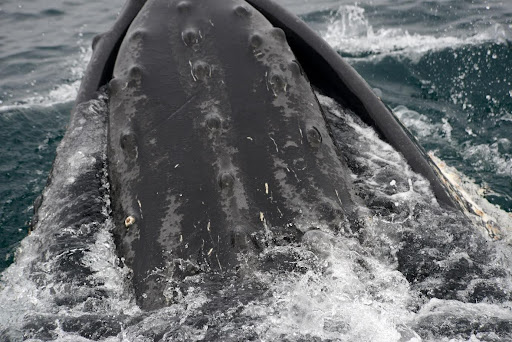 Close Your Mouth! After diving beneath the icy sea, this humpback whale surfaces through a swarm of krill struggling to close its mouth but valiantly tries, by bringing the water/krill-filled basket-shaped lower jaw towards the flat upper jaw. In so doing, it filters the krill through its baleen. Photo: M. Jenner AM
The overnight data from the archival Whale Lander tag deployed on a humpback whale named “Tiny Lander”, showed finer scale movements such that cooler water was associated with a higher feeding rate.
 The Whale Lander Tag. The Whale Lander archival tag that remained overnight on the back of a mother humpback whale we called “Tiny Lander” provided fine scale movement data while she was feeding. Photo: M. Jenner AM
 Perched Right There! Positioned on “Tiny Lander’s” back, this archival tag was a valuable addition to our equipment for this project, especially since it is retrieved and reused! Photo: M. Jenner AM
These variations in behaviour using environmental cues to locate the krill swarms and then to effectively feed on the swarms, confirm hypotheses that the whales detect specific environmental conditions to locate their prey.
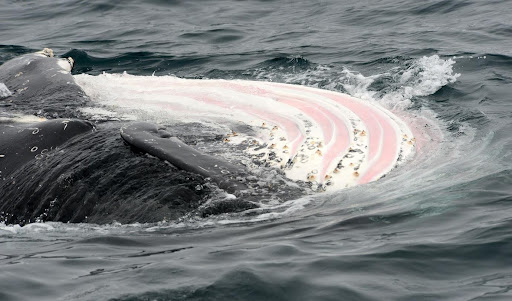 Pink Pleats! The side-ways movement of this surfacing feeding humpback whale reveals the extended ventral pleats. Wow! Photo: M. Jenner AM
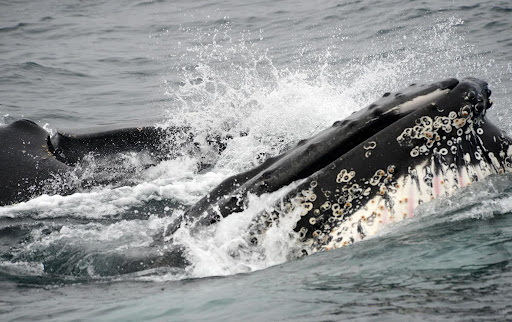 Krill is Up! The flat upper jaw is visible above the basket-shaped lower jaw which is extended and successfully brimming with krill. Photo: M. Jenner AM
Using one of many data collection tools available, the CWR Team recorded the acoustic detections of shrieking seals, trilling humpback whales and the grinding of sea-ice and calving of icebergs from glaciers. The Southern Ocean was alive!
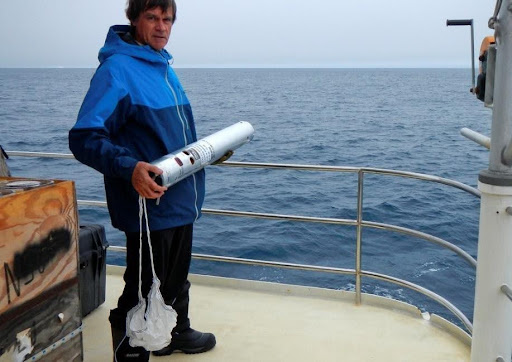 Sounds of the Sea. Rob deploys a sonobuoy with a hydrophone or underwater microphone which brings the sounds of the sea inside RV Whale Song’s wheelhouse! Photo: M. Jenner AM
In between all the scientific data collection, the unhinged energy of an approximately 6-month-old humpback whale calf was infectious!
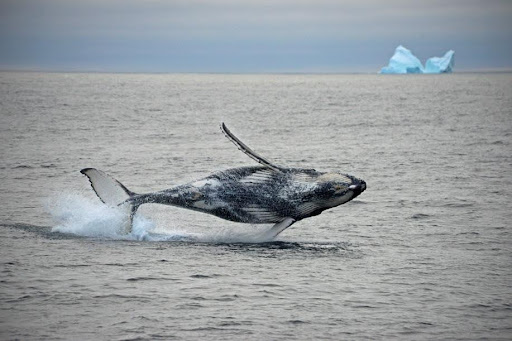 B-R-E-A-C-H! This little calf was exuberantly breaching without a care in the world! We hope it wasn’t scaring away the krill swarms its mum was targeting! Photo: M. Jenner AM
 Where is That Krill? Continuously towing the Biosonics Ecosounder while following the sat-tagged feeding humpback whales provided swarm depth and swarm mass data. Photo: M. Jenner AM
Overall, the authors noted that baleen whale foraging strategies may change with changing climate conditions within a season and across seasons encountered on their Antarctic feeding grounds. As a researcher, it was thrilling to contribute to the understanding of the minute details of humpback whale foraging in their unique and important southern polar feeding grounds.
Arriving home all safe and sound after a successful voyage we reflected on advice Curt’s hockey coach gave his team, “You’ve got to be good to be lucky and lucky to be good”.
We gave this voyage our best shot with careful preparation and were delighted with our luck, the research conducted and the adventurous voyage undertaken!
And for the record, our incredibly well-stocked medical stores were unused by our careful and competent RV Whale Song crew!
You can read the daily posts from our WAVES Expedition at the links below:
Day 1 WAVES Day 2 WAVES Day 3 WAVES Day 4 WAVES Day 5 WAVES Day 6 WAVES DAY 7 WAVES DAY 8 WAVES DAY 9 WAVES DAY 10 WAVES DAY 11 WAVES DAY 12 WAVES DAY 13 WAVES DAY 14 WAVES DAY 15 WAVES Day 16 WAVES DAY 17 WAVES DAY 18 WAVES DAY 19 WAVES DAY 20 WAVES DAY 21 WAVES DAY 22 WAVES DAY 23 WAVES DAY 24 WAVES DAY 25 WAVES DAY 26 WAVES DAY 27 WAVES DAY 28 WAVES DAY 29 WAVES DAY 30 WAVES DAY 31 WAVES
No comments yet.