
(Written by Micheline Jenner AM)
Scientific papers are written in a structured format to outline research conducted to answer specific questions across all manner of scientific endeavour. The research methodology, analysis, results, discussion and conclusions or answers are explained and available in the research paper for the scientific community and the general public through hard-copy journals and on-line research sites. The “why” of the research is addressed but the backstory of the “how” often goes unmentioned.
With these scientific paper posts, the papers, all of which CWR researchers Curt and Micheline have been involved, the more personal backstory of how the research was undertaken will be told.
The Reference
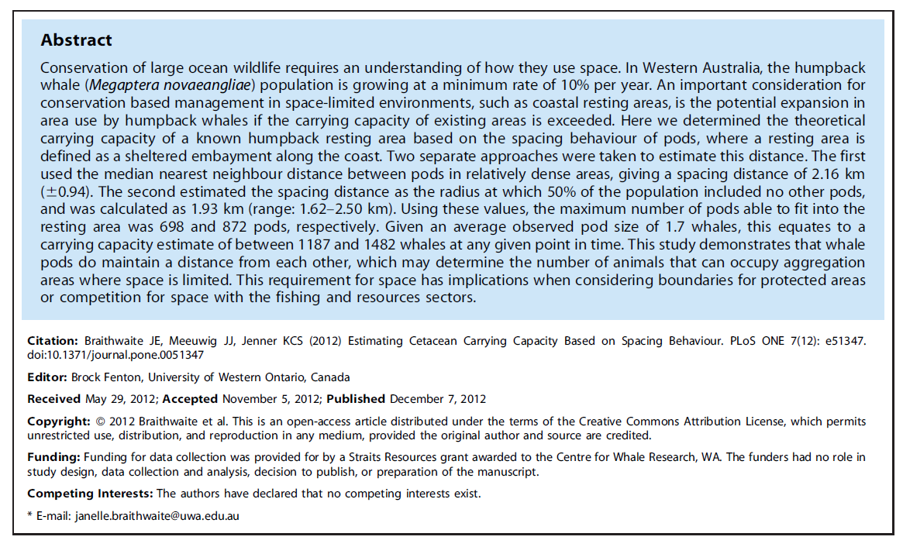
Braithwaite, J. E., J. J. Meeuwig and K. C. S. Jenner. 2012 Estimating Cetacean Carrying Capacity Based on Spacing Behaviour. PLOSONE 10.371/JOURNAL.PONE.0051347
(PlosOne Open Access)
The Title
Estimating Cetacean Carrying Capacity Based on Spacing Behaviour
The Abstract
The On-line Link
https://journals.plos.org./plosone/article?id=10.1371/journal.pone.0051347
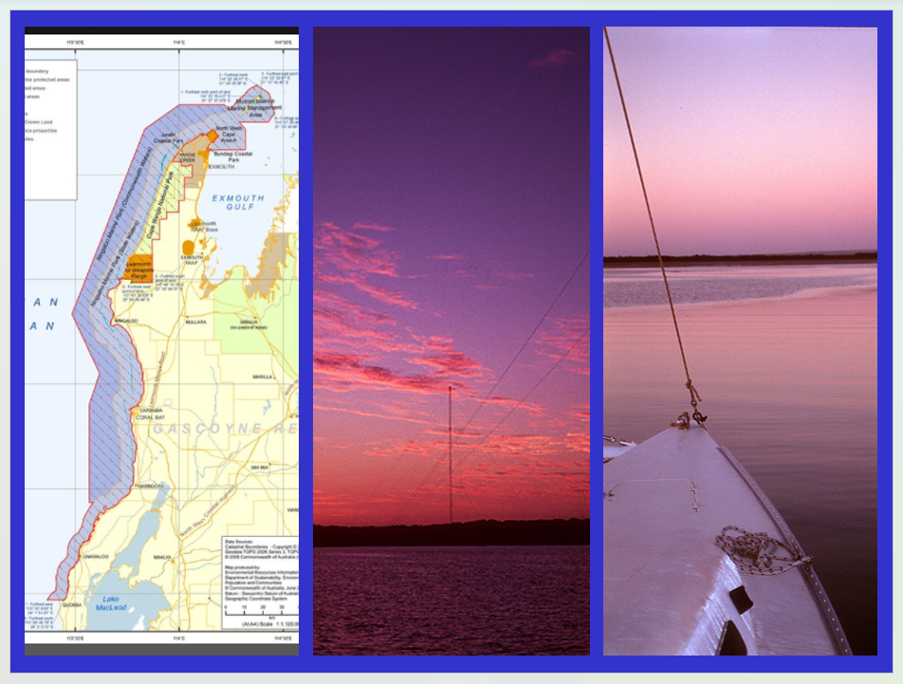
Seventeen aerial surveys of Exmouth Gulf were conducted from July 7, 2004 to October 15, 2005 to document the usage of the gulf by humpback whales visiting during two breeding seasons. When CWR crew observed humpback whales moving within Exmouth Gulf in October 1995, a quick check of the literature confirmed in the 1960’s whaling biologist, Graeme Chittleborough had reported Exmouth Gulf as a humpback whale nursery area. Four decades later, these dedicated surveys were undertaken by CWR crew to understand the temporal and spatial utilization by humpback whales of this nursery area in these tropical waters.

These aerial survey track lines eastward and westward across Exmouth Gulf with the humpback whale observations form the basis of the data analysed in this scientific paper to document humpback whale usage.
Through-out the northern migration, animals predominantly move in the offshore waters of Ningaloo. In the 1990’s, migrating humpback whales were travelling towards their northern destination, the Kimberley, which at the time was their main west coast calving area. In October 1995, when safely on a mooring aboard WhaleSong (our sailing the catamaran) we were puzzled when seeing a humpback whale exiting Exmouth Gulf. If it was heading north out of the Gulf, where had it been? The very next year we were interested to see just what was happening there and in fact, in those days, the gulf was used by cows and calves to rest on their southern migration. Male humpback whales, being male humpback whales, now follow the cow/calf humpback whale pairs into the gulf for the chance of continued mating opportunities.
With this WA humpback whale population (Group IV Breeding Stock) increasing at 10-12% annually and numbers of whales higher than 30,000-33,000, there are now so many whales mating early or late, hence there are many different southern locations where mothers are giving birth to their calves, including right in the waters of Ningaloo!
From our various research vessels (sailing catamaran WhaleSong, expedition vessel WhaleSong II and RHIBs) we often observed cows and calves breaching and playing in the lively seasonal SE winds. By early afternoon, the wind and the waves of Exmouth Gulf lay down, as the predominant SW sea breeze is conveniently blocked by Cape Range providing glassy, calm conditions for resting and suckling calves.
 Exmouth Gulf, a critical habitat for humpback whales, including resting cow/calf pairs and socialising, combative breeding pods. Deliciously glassy conditions ensue during winter and spring when humpback whales visit, an important stop on their southern migration. Photo: M. Jenner AM
Exmouth Gulf, a resting area for humpback whales – it is such a special place!
The Back Story of the Research – Is there Enough Space?
With extensive aerial surveys conducted within Exmouth Gulf and in the offshore waters of Ningaloo, on each flight we became accustomed to seeing numerous pods of humpback whales. With boat surveys as well, each day we encountered humpback whales just being humpback whales.
We saw them resting, lolling about at the surface. As still as logs – just as our North American colleagues describe this behaviour as logging. We saw them breaching, as if leaping for joy, exploding out of the water. Sometimes we saw serial breachers, or those we dubbed “push-button” breachers for their wonderfully predictive, continous leaping displays. Often, they focused their attention on fellow unsuspecting suitors, variously thumping right down on top of them! Either for fun or competition – their huge resultant splashes could be seen from miles away and we became adept at estimating the distance to the perpetrator and the behaviour causing the enormous splashes. Head slaps, peduncle slaps, fluke slaps, inverted fluke slaps, pectoral fins and even dual pectoral fin waves created huge recognizably-shaped white-water splashes. Other times, rowdy and lively combative male pods roared around at high-speed seeking out available breeding females, after all, it was the breeding season!
During hours of looking for whales in the glassy calm waters of Exmouth Gulf it was easy to see the spatial pattern of humpback whales regardless of age class. Cow/calf pairs, sub-adult and adult pods dotted the gulf, a pair there and a boisterous pod just over there. The sightings came rapidly and the note-takers quickly scribed all the details. Hundreds of sightings across pages and pages of sightings.
There are humpback whales everywhere! This is good, the pods seem to be just a perfect distance away from each other.
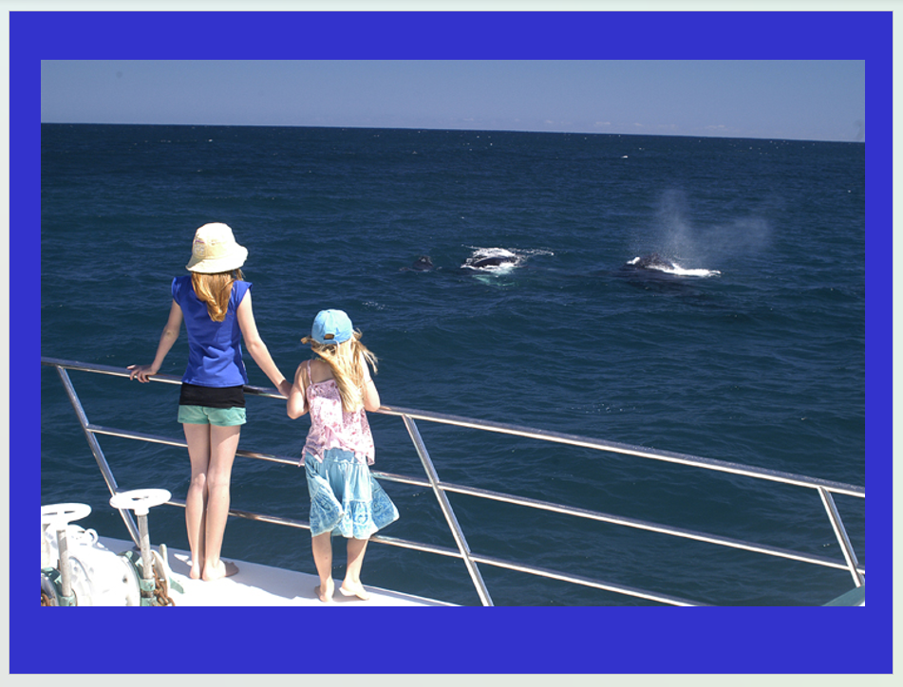 ‘Come and See!’ Micah (at left) and Tasmin were coaxed on deck (away from their schoolwork by their Home Tutor!) to watch a pod of humpback whales lolling about in Exmouth Gulf. Cow/calf/escort pods like this one are often encountered during the humpback whale breeding season. The calf of this year is laying just near the surface beside the mother and to her left is the escort, a male whale looking to further his mating opportunities with this female who is clearly a successful breeder. Photo: M. Jenner AM
During two road trips a couple of interesting biological observations were made, one close to home in Western Australia and the other on the other side of the world.
With our research based in the Dampier Archipelago for the first 5 research years (1990-1994), Curt and I made our own annual northern and southern migrations, like the whales, but overland throughout the beautiful arid country of the Gascoyne and Pilbara regions in Western Australia. Encountered between Shark Bay and Karratha, the scattered and not-right-next-to-each-other red-mud termite mounds amongst the spinifex bushes and small, low native shrubs adjacent to the roadside caught my attention. The visual concept of each termite community maintaining a possibly specific “distance” from another mound probably due many factors, possibly including the spinifex required to sustain the community, was intriguing. How do they know? Each time we travelled the arid highways I thought of the termite mounds and secretly admired their careful and deliberate mound planning and community spacing.
Driving within the Province of Alberta during a White Christmas visit to Curt’s Canadian family and homeland in 2007, the stark wintry regional scenery was captivating. Known as Cattle-Country for Alberta’s numerous beef cattle ranches, the rolling paddocks extending to the horizon, cloaked in 8ft deep snow were variously punctuated by small stands of tall, bare-branched trees. These isolated groves, all without a single leaf, revealed huge nests contained within the tangled branches. As we whizzed past one stand after another dotted across farmers’ properties, I noticed a pattern. Only one nest existed in each stand. From the back seat I queried “What species of bird has built those nests?” Satisfied with the answer that a blue jay was responsible, I wondered why was there only one nest per tree? So many questions raised on holiday Christmas road-trip!
My thoughts swirled as everyone hummed along to the latest Canadian radio Top 40. The bird’s nest with its attendant bird was like the termite-filled mound and the space between the next nesting bird in another stand of trees, was like the distance between the termites’ mud-packed structures.
Back in Exmouth Gulf that next season, the floating “whale-islands” with their splishy-splashy small calves, nicely spaced about 1 nautical mile away from each other reminded me of the termites and the birds. Seated in our observation tower above the top deck of WhaleSong II small and large puffs and blows or enormous splashes dotted the table-top calm waters.
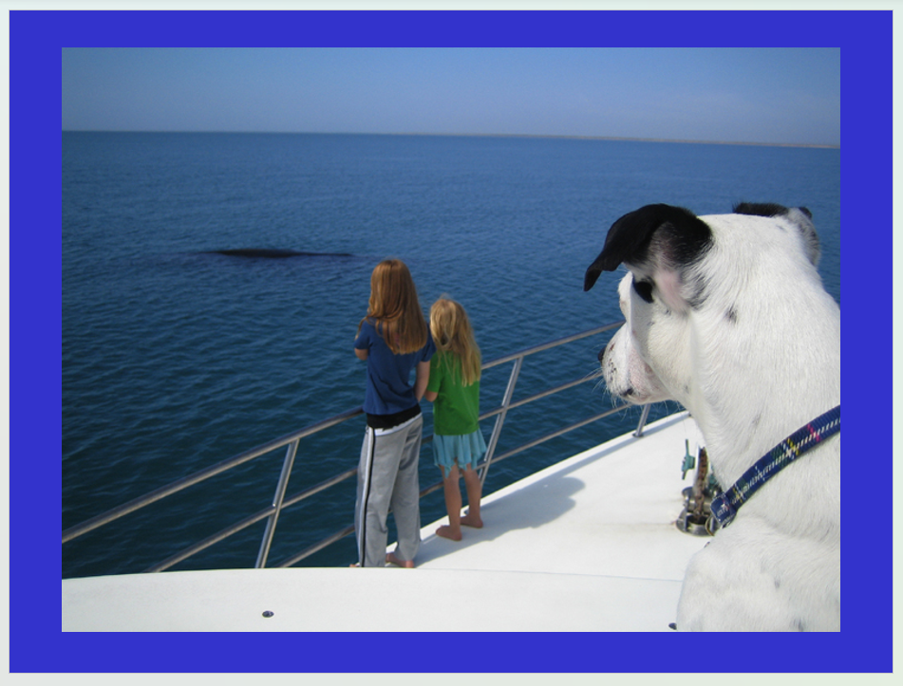 Whale Islands. Floating “whale islands” have the attention of Micah (at right), Tasmin and Skipper (our ship’s dog) and they deserve our on-going protection and conservation. Photo: M. Jenner AM
Available space for individuals and communities to thrive on land and at sea is important. Space is a resource, just like food. If space is limited? What happens if there isn’t enough space for humpback whale pods to mate, give birth, suckle, rest and play?
With the thoughts of how space was critical to the survivorship of termites and birds and, also humpback whales in Exmouth Gulf, Janelle expertly and carefully worked the numbers of these aerial surveys and indeed space is critical as observed in the plane observers and from our vessels.

First Breath. Photos of this newborn humpback whale calf were opportunistically captured just after it’s birth, near Tandabiddi, Ningaloo Reef. Photo: M. Jenner AM
It is important to continue monitoring the Group IV Breeding Stock humpback whale population, since even though their population numbers are increasing well, there are always hazards around the corner on their WA migration, literally. Every year there is another water or land-based development proposed for Exmouth Gulf which needs addressing. And now even more threatening for Australian avian and marine mammal populations is the spread of the deadly H5N1 virus.
Fortunately, the new Exmouth Gulf Marine Park (the details of which are being finalised) will provide necessary protection for humpback whales and hopefully resilience in the face of threats from development and the H5N1 virus. Exmouth Gulf is a critical habitat for humpback whales during their important life stages of mating, calving and resting.
Considering the “big-picture” for protection of humpback whales and all the animals visiting and inhabiting this north-facing bay – Exmouth Gulf deserves National Heritage listing and then World Heritage listing (in line with protections for Ningaloo Reef) due to its geological, biological and ecological significance.
Let’s continue to understand and protect this vital habitat with the highest conservation status!
No comments yet.