
Scientific papers are written in a structured format to outline research conducted to answer specific questions across all manner of scientific endeavour. The research methodology, analysis, results, discussion and conclusions or answers are explained and available in the research paper for the scientific community and the general public through hard-copy journals and on-line research sites. The “why” of the research is addressed but the backstory of the “how” often goes unmentioned.
With these scientific paper posts, the papers, all of which CWR researchers Curt and Micheline have been involved, the more personal backstory of how the research was undertaken will be told.
Here is the first of many scientific papers published by CWR scientists,
enjoy the science and the personal stories involved!
The Reference
Jenner, K.C.S. & M.-N. Jenner (1994). A preliminary population estimate of the Group IV breeding stock of humpback whales off Western Australia. Rep. int. Whal. Commn 44:303-307.
The Title
A preliminary population estimate of the Group IV breeding stock of humpback whales off Western Australia
The Abstract
Data collected in 1990, 1991 and 1992 from a photo-identification study of humpback whales (Megaptera novaeangliae) off northwestern Australia have enabled the calculation of a preliminary population estimate of the Group IV breeding stock. The Chapman modification of the Petersen population estimate resulted in a 1990-1991 estimate of 2,736 (928: 9,928 95% CI) and a 1991-1992 estimate of 3,878 (1,319: 14,108 95% CI). The 1991-1992 estimate is considered the more accurate and is similar to a population point estimate of the same stock calculated from aerial surveys in a separate independent study.
The On-line Link
https://researchdata.edu.au/geographical-temporal-movements-australian-waters/3984683

In 1990 when this research was conducted, as shown on the map below, humpback whales almost exclusively migrated southward past the Dampier Archipelago on the northwest coast while their northern migration was by and large situated 40-50 nm to the north.
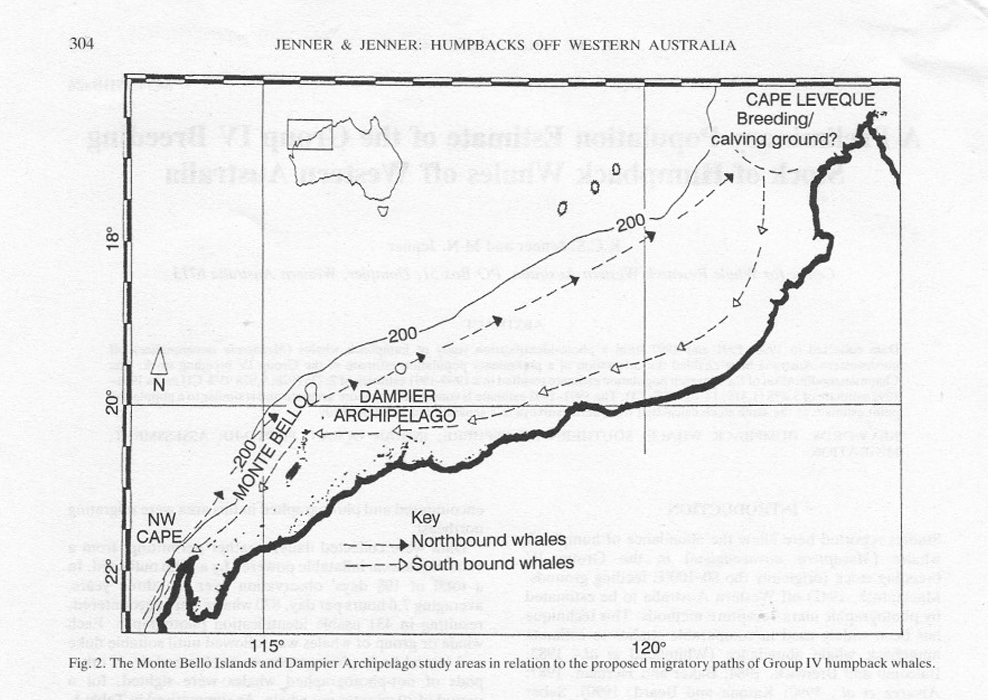
Nowadays, from recent observations made while travelling aboard RV Whale Song along WA’s coast, both northbound and southbound humpback whales are encountered on the migratory “humpback highway” on the more inshore route which had previously been described as the southbound pathway. Times have changed as the population increases and humpback whales are filling many bays and island groups along the coastline, where humpback whales likely were prevalent prior to the settlers intense whaling pressures.
The Back Story of the Research – How Many Humpback Whales are in NW Australia?
A preliminary population estimate of the Group IV breeding stock of humpback whales off Western Australia
This first paper written by Curt and Micheline Jenner details a preliminary population estimate of humpback whales passing their “photo-booth” during austral winters of 1990-1992 in the offshore waters of the Dampier Archipelago in northwestern Australia. Their Dampier Archipelago Humpback Whale Research Project operated from a “5-star” research station on Enderby Island, one of 42 islands and islets of the Dampier Archipelago. Over five years for five months at a time during winter/spring, every day (weather permitting), small boat research was conducted to collect a variety of data including humpback whale photo-ID, skin biopsy samples and acoustic song recordings.
This humpback whale photo-ID project was aimed at understanding if, and to what the extent, this Group IV population had increased 30 years after the cessation of whaling. In WA, only 200-300 humpback whales remained in this population in 1962 when whalers realized it was becoming uneconomical to continue their catches. With most of the remaining animals being immature males, it was intriguing to find out just how this Group IV population had faired some 3 decades later.
A scientific paper captures the essence of the research endeavour and its outcomes, but the whole picture of a research project is also created with the words of our lived life experience collecting this information.
A remote desert island – tick
Hot dry climate – tick
Windy winter weather – tick
Long sundrenched/wind-wracked days – tick
Mosquitos & Sandflies – tick
Stonefish – tick
Blue-ringed octopus – tick
Humpback whales by the dozen – tick
Our five seasons living-in-nature on Enderby Island (Enderby-earth, as we called it) were remarkable, totally unforgettable and brought an incredible connection to our study animals and our unique desert landscape.
Would I do it all over again? – tick, in a heartbeat!

Taking care of weather day data jobs from our outdoor “office” on Enderby Island, from left EARTHWATCH Volunteer Jim Nahmens and CWR whale researchers Curt Jenner and Micheline Jenner. Photo: C. Jenner AM
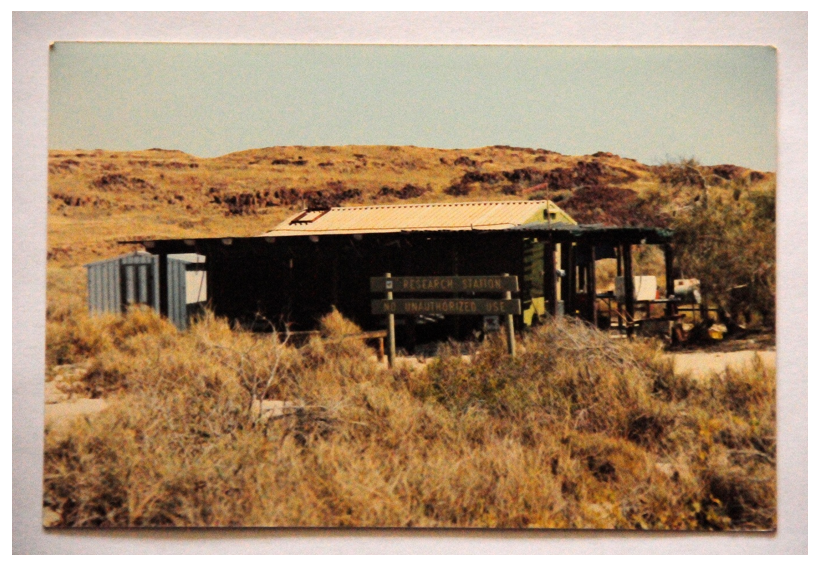
The Department of Conservation and Land Management “5-star” Research Station on Enderby Island in the Dampier Archipelago where the Dampier Archipelago Humpback Whale Research Project operated from 1990-1994. Photo: M. Jenner AM
No comments yet.