
Days 15 to 19
Day 15 Long Island to Onslow Soundings (Written on Oct 12, 2013)

Tropical sandy spit at Long Island,
NE of Exmouth Gulf.
Photo credit M. Jenner
Another gorgeous day dawned while Whale Song swung gently at anchor on the SE side of Serrurier or Long Island. Today is all about comparing tools and techniques employed for determining turbidity. We used a traditional instrument (a CTD unit, a Conductivity Temperature Depth instrument) versus an echo-sounder, to compare accuracy and capability. This promised to be very interesting.
At 1300, after lunch we raised the anchor, leaving our lovely anchorage at Long Island and commenced a course-line or transect while towing the Bio Sonics echo-sounder for 6 nautical miles. Returning on the same track, towards the SE tip of Long Island, we made 5 CTD drops, for comparison.
At 1612 having completed the CTD drops we made our way towards Tortoise Island and then Mary Anne Passage inside close to the coast and then we chose a course for the open water heading for Scott Reef.
The water seemed more normal today, a bluey-green with a hint of mud. As we left Long Island on Thursday morning, the water was a displeasing chocolate-coloured tone and very stirred up. Chocolate is for eating, not for boating on!
We will head through the night now and get back into our transiting regime. I am missing Tas’s Bananagram games already. To make it harder for her we made her play her letter tiles upside down and then with four and five letter words, only, briefly slowing her down! For dinner, Resty made “KFC” style chicken legs with chicken fried rice and salad – just yummy!
With a high blue Pilbara sky whipped by dust on the horizon
Mich
Day 16 Pilbara Passage (Written on Oct 13, 2013)
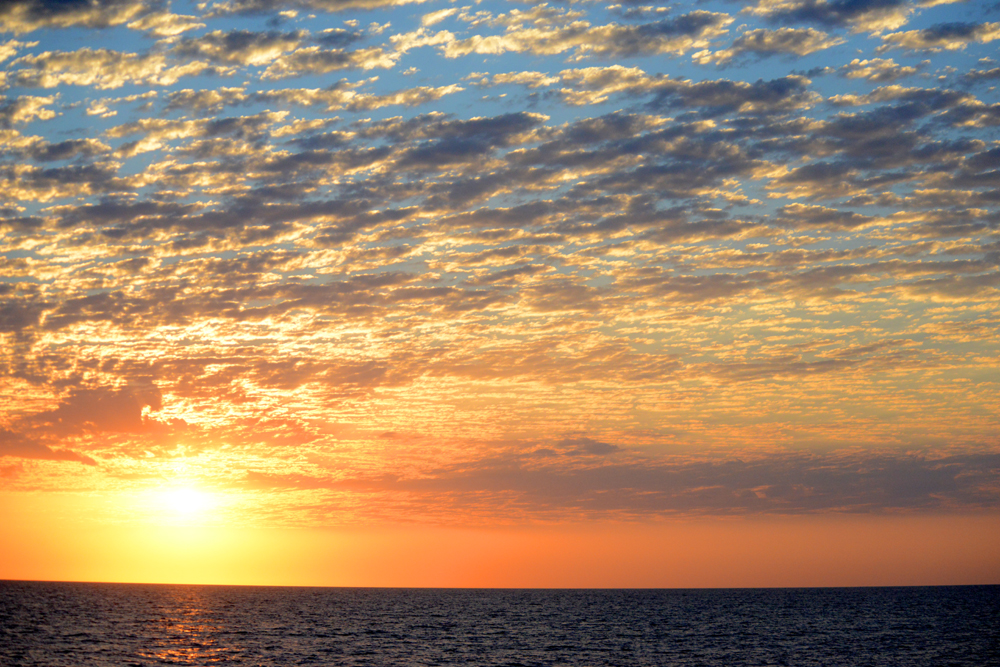
Another glorious Pilbara sunset!
Photo credit M. Jenner
After our turbidity readings yesterday, we continued travelling northwards, through Mary Anne Passage and now here at midnight, transiting on the eastern side of Barrow Island, heading 025 degrees along the Pilbara coast. The names on the chart in this area trigger many happy memories. Humpback surveys at the Montebello Islands (formerly spelt Monte Bello Islands), diving work near the Lowendal Islands and Airlie Island and our main field work of humpback whale research for 5 years camped on Enderby Island, in the Dampier Archipelago.
Our course, this morning, took us past 37 vessels anchored near Barrow and another 4 vessels anchored north of the coastal-oriented Passage Islands. What a hive of activity here. We proceeded past Wandoo A and Dampier Spirit towards an arc of oil/gas rigs including Pluto A, Goodwin A, North Rankin, Cossack Pioneer, Angel, and wellheads Karratha Spirit and Ocean Legend. The wealth of Australia comes from this region, despite what everyone else thinks! The NW Shelf with oil & gas, iron-ore pre-processing and salt evaporation from this area of the Pilbara, has buoyed Australia through global crises, thick and thin.
On my midday watch, we passed the northern tip of Glomar Shoals. Six small baitfish balls broke the surface with much splashing and thrashing of fish. Bridled terns or wedge-tailed shearwaters flock overhead, seeking their fill of tit-bits from the swirling fish. This area, Glomar Shoals, reminds me that seven years ago, we observed a vessel anchored here for a few days. As we drifted nearby overnight, we noticed that the ship left the area before daybreak, but not before cleaning/flushing their fuel tanks during the night and then treating the mess with dispersant. In the morning, Curt and I were shocked to see fuel moose and dispersant goo floating widespread with the vessel absent. This vessel was reported and justice duly applied. Today, I am glad to see these sploshing fish got another chance!
Through-out the day we had a few cetacean sightings, a pod of 10 or so large bouffy offshore bottlenose dolphins perhaps as a mixed pod since we saw 2 animals with large dorsal fins, perhaps 2 Brydes’ whales with them. Thirty minutes later, 4 spinner dolphins with fine bodies and a light grey cape swing nearby, for us to see them underwater.
The breeze continued to reduce as we head north. We look and look, under a warm sun and an increasingly cirrus-filled sky. The shipping traffic also reduced as we head offshore, but despite the good conditions our whale sightings are few. The humpback whales are inshore on their southern migration route. We are taking the fastest way from A to B, so obliquely crossing their migration path and will look for what we can find, as we travel offshore.
Cloudless for several days as the afternoon progresses, soft cumulus cloud appears, becoming more predominant and bringing a beautiful backdrop to the sunset. On deck as the sun dropped, cameras were poised to record the potential green flash… despite the clear horizon, a yellow rather than green flash occurred. It was “a Kodak moment”, if we can still refer to continuous clicks of camera shutters as this!
Heading towards Rowley Shoals for daybreak – Yahoo!
Mich
Day 17 Offshore Searching and Blue Finding (Written on Oct 14, 2013)

Fine scale blue whale observation notes taken from the flybridge.
Photo credit I. Ford
At least sixty-seven vessels, shown by their AIS (Automated Information System) targets on the nav computer in the Dampier and Port Hedland region, are on the move or anchored. The ships’ AIS signals, a white triangle (the vessel position) and 10 nm long blue lines (indicating the ships’ course), criss-cross the chart like a tangled spiders’ web.
The first two hours of my watch were totally engrossing while watching the chart and planning an approach with a passing vessel. A polite conversation followed on the VHF. I call to ask if the Watch-keeper on the said vessel is happy with our starboard to starboard passing, since usually traffic manoeuvres port to port. We plan our passing one hour in advance, with information available on board both vessels, namely RADAR and AIS giving SOG (Speed over the ground in knots), COG (Course over the ground in degrees), CPA (Closest Point of Approach in nm) and TCPA (Time to CPA in hr/min/secs). Direct but polite, we both concurred our current courses will be suitable for safe passage and I wished him a good journey, and he me, as we both switched from Channel 06 back to Channel 16 to monitor the universal distress channel. I figure, his ship is 299m long and SIZE does matter in this game! I like speaking with ships as we travel and over the radio my voice booms in my radio voice!
Just as I finished the last readings for the 0300 am ships’ log entry, we are only a few miles from crossing a busy traffic-way. “We are on the shipping line between Port Hedland and Singapore, iron ore is leaving Australia. This vessel has gone passed, this one heading across us towards Port Hedland has a CPA of 2.5nm and has just slowed from 14 knots to 13 knots. This vessel here, going to Singapore has a CPA of 3.6 nm and the one behind, has a CPA of 5.4nm. The one to really watch is the Port Hedland-bound one” This explanation is for Simon as he comes on watch for 3 until 6am, and as such, I brief him on our location, local weather conditions and the current traffic situation, being our usual crew-change hand-over.
After dawn and on our current course, we travel within 10 nm of the western side of the Rowley Shoals. At 0910, Curt raced down the stairs announcing excitedly, “We have a killer whale detection!” Immediately everyone takes stations in the wheelhouse and on the fly-bridge peering through binoculars in the direction of the sounds… 045 degrees, this is the way we are going, it is to the NE of the sonobuoy and thus behind us… the white-caps and slightly choppy seas do not help. Soon out of RF range with the first sonobuoy, we deployed a second sonobuoy and make another killer whale detection at 270 degrees! Our eyes are peeled, but sadly no killer whales appear from beneath the 18-20+ knots water. On the second sonobuoy, every 4 minutes a Brydes’ whale can be heard, calling at 25 Hz.
At 1000 we can see the green glow of the lagoon of the southern reef of the Rowley Shoals, Imperieuse Reef. We travel 4.18 nm at our closest point to Cunningham Island at Imperieuse, desperately looking for anything. Next along our trackline, Clerke Reef with a large and deep lagoon and Bedwell Island positioned to the north. The sea is confused – a SE wind and SW swell and reflections from the reef as well, bring scattered sploshing waves breaking as the wind and swell meet.
After lunch (salami, salad, ham, cheeses and grain waves) as we made our way the wind chop and tidal streams reduce and the blue sea and blue sky take over…
1600 on the dot a blow appeared and we have a sighting! “I’ve got a blow, yahooooo!” I roar! “And again, it’s at 030, point 7 miles!, Yahooo!” Curt takes the helm and brings Whale Song towards the narrow blow. Three blows are counted and then we start timing the downtime. Nineteen minutes later the whale surfaces, just 0.5 nm ahead, it is migrating south and on the move. Next 5 blows are counted, “Two…., three, four…” all yell out across the deck. Carrie makes fine scale notes on a data sheet on the top deck with me. We look and look for the blow, into the glare, until we see black dots everywhere. Next after 12 minute downtime we see 4 blows. The fine, straight blows, grey body, small and well, set-back dorsal fin, all indicative of a pygmy blue whale! It is warm, no hot, as we track this animal. For the last downtime we are again looking into the sun and we must miss a surfacing. At 23 minutes, Curt pulls the pin, saying “We will break from pod 1”. In neutral, we dropped a hydrophone to record any calls the animal might be making. As we finished collecting 5 minutes of recording, just 0.2 nm from us three blows appeared. With the setting sun behind to the west, the blow is golden and the body of a 20 m pygmy blue whale arches on its’ southern migration. At 1745 we left our friend to travel over the horizon from the northern waters to the temperate Perth Canyon and beyond to Geographe Bay and even to the Bonney Upwelling in Victoria.
“We have to head north, or we’ll be back in the Perth Canyon!” Curt declared. “This is my favourite sort of hot and starving, all happening while following a blue whale, Yahooo!” I share this with my blind, hungry and busting team-mates as we tracked a blue whale!
Some might ask, “Why follow blue whales?” I think we have a new creed for this work. It shall be our blue whale creed. Not unlike the mountaineers creed, “Because they are there” is my answer.
Resty prepared yummy special noodles in two huge platters. We are hungry and happy, although half of us are still grimy from being on deck in the warm sunshine… food wins for me. I am afraid my table-mates will have to take me grimy but OH-SO-Happy! We toasted our first blue whale of the season! Wahoo!
From a glassy calm and dripping wet night west of Mermaid Reef,
Mich
Day 18 Rowley Shoals to Scott Reef (Written on Oct 15, 2013)
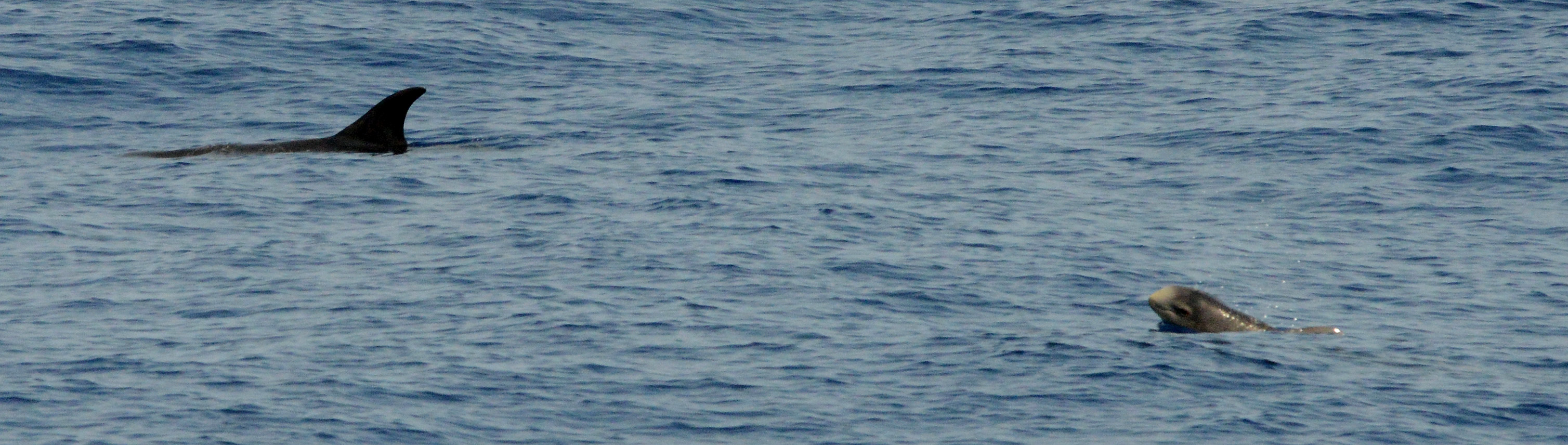
A pod of Frasers’ dolphins including small calves keeps us clicking away on our cameras.
Photo credit M. Jenner
At 0100 am we are 26 nm north of Mermaid Reef, with 190 nm to go until Scott Reef. This morning the traffic was quieter and in fact, only 6 vessels grace the screen with their blue AIS signals. Moonlight from a ¾ and waxing glowing disc, casts gorgeous light on the water. Twenty minutes of my first hour is spent on deck looking for whales in this calm weather.
The deck is wet, the railings are moist and a drip down the back of my neck reminds me that it is sopping wet on the fly-bridge as well. This is what Curt calls “high levels of humanity”. Imagine if I see a whale tonight! This wouldn’t be the first sighting in darkness, but given our locale and the interest in these blue whales – I am certain, I will have to wake people. Also given peoples’ need for sleep, I decided that I will cross this bridge when I come to it…
On deck, my shirt gathers airborne moisture and once inside again, the cool of the air-con makes my damp shirt feel like I am wearing a personal fridge! A new form of Coolgardie cooler! Our BOM weather station readings show the dry bulb at 26.5 degrees C, the wet bulb 26.5 degrees C and the SST is 26.7 degrees C. Wow, the sea is 0.7 degrees warmer than the air! Yes, I love this offshore environment!
A pod of 20 dolphins keeps us engaged in the morning. They are dispersed in at least 3 separate groups and just lying at the surface. Clumps of two and three small, rounded bodies are almost motionless on the water. They were resting communally, close to each other. Carefully looking for a beak or rostrum, I take a few photos, 94, to be exact! Suspecting they are Frasers’ dolphins, I deliberately focus on the tip of the rostrum and beak area. Upon review of the shots in the shade of the wheelhouse, sure enough, they are Frasers’ dolphins, a short-beaked species found in deep, tropical waters and this is where we are! Spinner dolphins, numbering 50, leap and splash characteristically. Stopping for thirty minutes to track a minke whale, seen with one body as the sighting, the ambient temperature heats us thoroughly, sans the ships’ forward moving “fan”. We are indeed in the Kimberley in October! It is always warm and I absolutely love it!
After lunch, we set an array of four sonobuoys for call detections and calculations using MatLab. Sadly, a merchant vessel ruined the RF (the radio frequency) for most of the life of our sonobuoys. We are starting to understand how the whales must feel with such a noisy ocean. Blue whales are lowering the frequency of their calls by 0.3 Hz annually, reported by colleagues in a recent scientific paper. Perhaps, they are switching channels to drop below the shipping frequency, also around 20 Hz. Fin whales also call at 20 Hz, Roger Payne surmises that 99% of a fin whales’ evolutionary existence has been without vessel noise. Its’ a blight on humans, that 1% change, could be so influential.
What is in store for tomorrow? Ever a surprise!
A smoky and tangerine sunset lightens high cirrus clouds on a Kimberley sky,
Mich
Day 19 Supreme Seringapatam! (Written on Oct 16, 2013)

An extremely young false killer whale – complete with foetal folds!
Photo credit M. Jenner
At 0100 we are 18 nm to the SW of the SW corner of Scott Reef. This ancient coral atoll rising from the depths continues to amaze. A static structure, but yet it supports a dynamic system. Friends in calcium carbonate colonies, corals, show us the values of community. Territorial fish whom tend tiny plots of coral and algae, know the value of caring for their home.
Passing on the west side, a single traditional Indonesian fishing vessel sails back and forth across the lagoon of Seringapatam, a reef 30 nm to the north of Scott Reef. Bright blue sails, a main and a jib, give a butterfly appearance. The scene is surreal, a wide blue sky expands above a petite wooden vessel dressed with silken sails. This cloth, so held aloft, brings fishermen 6 days journey south from Indonesia to Seringapatam, in Australian waters. As we rounded the northern edge, the colours are insane. Kimberley blue sky, bright blue sails, the brown tones of the boat floating atop dark blue water in the deeper, central lagoon or beside shallow, lime green water, which is just over the rim of this circular reef system. Scattered exposed bommies (large coral heads) are coloured ochre brown and even with the dropping tide larger reef platforms become high-and-dry. Just outside the circular reef system, patches of sand, made by parrotfish pooping chewed coral, form pockets of intense turquoise blue water. Close to the turquoise hues and within half a nautical mile, the depth falls away steeply to 600m and a deep electric blue overtakes. Cumulus clouds gather over the lagoon as the day temperature climes and the humidity builds. The flat bottoms of the cumulus reflect the lagoon with luminescent lime green. I am in heaven. I must be! I remember the first occasion we experienced such a sight prompted new desires. “Curt, I have a new want – please take me to the green clouds!”
The echo-sounder indicates a multitude of biological material, potential whale-food, so we deployed the Bio Sonics echo-sounder on a tow-fish and make a series of 7 transects zig-zagging between Seringapatam and Scott Reef for the entire afternoon. Our eyes are peeled and with great excitement, Inday called in a cetacean sighting. Splashes are seen and the dark dorsal fins of blackfish appear – with the binos Curt determined they are false killer whales. It is a widespread pod with small groups of mothers and juveniles close together. A playful calf shoots straight out of the water, captured on camera! The animals of the pod are scattered widely over 1.5 nm. On the outer, the large males of the pod, splash and porpoise at the surface. The calm sea shows every splash as a beautiful white-water spray. I get a few hundred photos and we make a positive identification that indeed they are false killer whales! Yea! Back in 2008, we observed a pod of false killer whales several times here, to the NE of Scott Reef, I wonder if, these are they… we shall check our photos and see if any matches can be made.
Under a glassy moon, we enter the reef to anchor and listen for whales and dolphins,
Mich
Hey guys!
Excellent shot of the young False Killer!! wow!!!
Loving your adventures/work =)
Ciao
Chris