
Aug 14, 2014
Smoke surrounded Whale Song as we lifted our anchor at 0755 and left the bay beside Lord Island and Byron Island in the Buccaneer Archipelago. Every now and then, pieces of leaf and bark blackened as ash, drifted by. These were tangible reminders of the bush inland to the east, where the smoke billowed. The haze was so thick, I am sure if we were in the city, public asthma-advisories would be issued on radio and television stations for people to stay inside.

In the Buccaneer Archipelago, the whales seemed to respond to the breezy weather with active behaviours. I always like to see the pink colouration near the pectoral fins – they have pink armpits!
Where will we find whales doing what, today? We are on a mission and have been for the last 25 years, to find out why whales do, what they do. Many factors influence their behaviours and why animals do what they do and go where they go. This is the under-statement of the year for biologists. Fine-scale and broad-scale patterns of animal distribution are our raison d’etre. Understanding these elegant patterns can keep scientists engaged for decades of their professional lives. For humpback whales, seasonality, by way of day length and sea water temperature, appears a major driver initiating migration to and from the Antarctic feeding grounds and the Kimberley breeding grounds. Today, we continued to survey for whales through the Buccaneer Archipelago, most interested in recording physical factors possibly influencing their presence. Currents, tides and water temperature certainly are subtle and non-subtle factors, influencing where humpback whales migrate, rest and play in the Kimberley and also for the entirety of their migration path.
In the rough south-easterly wind, the whales were stirred up breaching and pectoral fin slapping. Sometimes, it does seem as though the whales respond to weather, being lively and boisterous in rougher seas and calmer and relaxed in flat, ocean conditions.
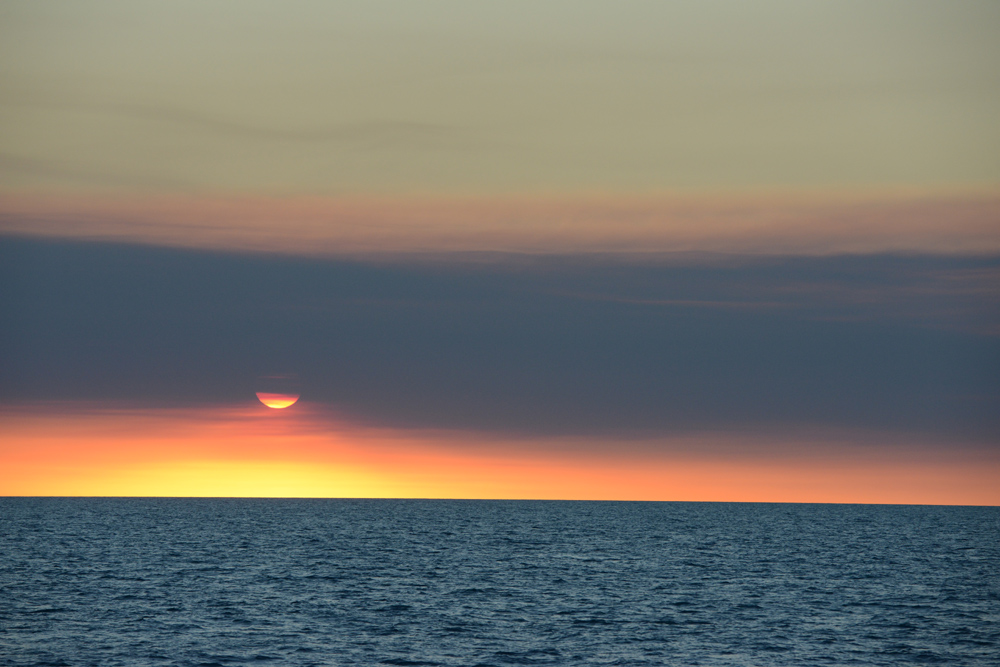
At least two wild bush fires filled the sky with smoke and ash giving the sunset an eerie feel.
The smoke made the sky a flat blue-grey tone. Sadly, the zing of the Kimberley blue sky was missing. Fire, a natural seasonal component from lightning, but often human-induced, can be the stimulus for new vegetation growth. Germination is often stimulated in fire-tolerant species (pyrofiles) once the outer layers of the seed are exposed by burning. Even certain insect species are fire-stimulated and respond to hot, forest embers to progress through certain phases of their life cycle. This is the cleansing cycle of life. Even in death, new life will flourish.
Enjoying the calm sea at sunset,
Mich
No comments yet.