
Day 2
Will a Blue Whale Do? (Written on May 03, 2015)
Dales’ baked snapper with salad and Restys’ special baked potatoes were a lovely treat for our meal at the start of our journey. As the evening had worn on the light winds continued such that the moon rose from the east, over beautiful calm water. Even appearing glossy, the swell gently lifted us at the crest and kindly lowered at each trough towards out tropical destination. Cloud, now almost 8/8 (totally overcast) hides the stars that came out to play earlier in the evening…
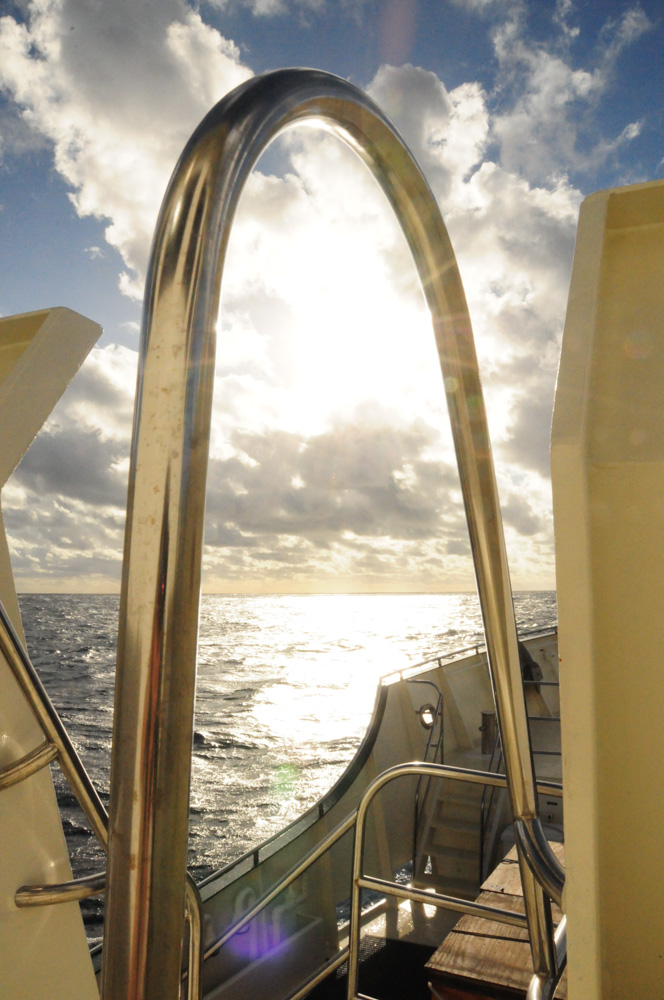
Sunset at sea, my favourite time and place!
Blue whales boomed calls, recorded on the equipment in the 6pm and 9pm deployments. Amazingly, one whales’ call was so loud that it entirely blocked all the other ambient noise. Now that’s a voice of which, one must take notice. How about owning a voice like a 747? Imagine how they must shudder themselves as they call in such low tones. In some systems when we listen with a sub-woofa, you can feel the call. “We have whales – there are four more recorded this hour” Carrie informed the wheelhouse regarding the last deployment. I fear this over- abundance of pygmy blue whale recordings will make us blasé. I never wish to become blasé about any aspect of a blue whale. “Oh, this is good, there’s another one calling on that bearing” Rob said during the next deployment. I will make every one count.
It is awesome news that we are hearing so many pygmy blue whales, but bodes slightly strangely, for the title of these blogs. Clearly, the humpback whale season will begin soon, but right now, the pygmy blue whales’ are getting all our attention! In 1990, Curt and I, in our mid-twenties and full of vim and vigour ventured from North America to Western Australia to begin our first humpback whale research project in the Dampier Archipelago. We were based on a desert island, an A Class Reserve and the 5-star rustic research station (a very grand title mind you!) where we spent 5 five austral winters was surrounded by red iron-ore rich rocks, spikey spinifex and rare Rothschild rock wallabies. We lived in nature and knew all the birds nesting in their various habitats and the rhythm of life on the island. As well, we knew where to find humpback whales migrating on the Humpback Highway!
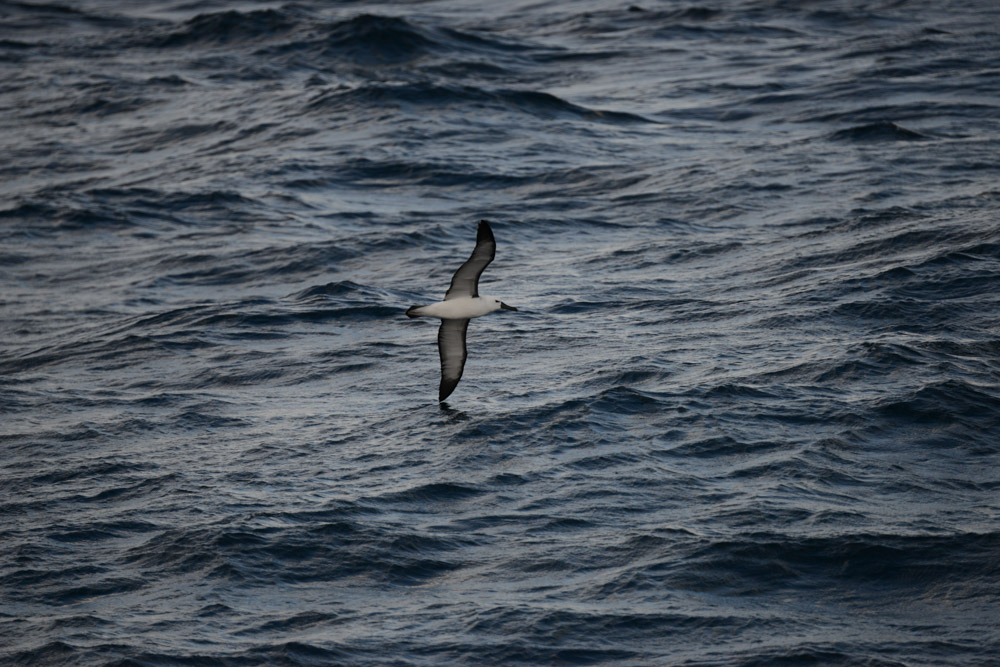
The tip of a juvenile Yellow-nosed albatross almost touches the wave
as it glides millimetres above.
Looking back a few decades, I could not have imagined all the cetacean data we would collect, all the projects and types of data record and all the places where we would venture. The 2015 season marks our 26th research season in Western Australia observing humpback whales and the 16th season for pygmy blue whales. What a journey! Thanks for all the whales!
After lunch of chicken, salad and stir-fry with rice, we all got very excited about three tall blows that were seen on our starboard side 2 nm away… we are hearing whales and now seeing them!
A seafood extravaganza, firstly provided by Dale and now Rob puts banana prawns on the menu, wow what a treat! Resty’s special fried rice with buttered pan-fried zucchini and garlic prawns has Curt wondering out loud what the next meal will be… baked beans he supposes for tomorrow!
More pygmy blue whales call on the sonobuoys – they really are a chatty lot! Soon I shall do the nine o’clock deployment, what will I hear then? Such a lovely question and we do feel honoured to answer it.
Here’s to many more fun years with whales collecting various types of data to understand many different and varied aspects of their interesting life cycles, so we can better protect their important habitats.
Passing the northern end of the Abrolhos Islands and on into the night…
Mich
No comments yet.