
Scientific papers are written in a structured format to outline research conducted to answer specific questions across all manner of scientific endeavour. The research methodology, analysis, results, discussion and conclusions or answers are explained and available in the research paper for the scientific community and the general public through hard-copy journals and on-line research sites. The “why” of the research is addressed but the backstory of the “how” often goes unmentioned.
With these scientific paper posts, the papers, all of which CWR researchers Curt and Micheline have been involved, the more personal backstory of how the research was undertaken will be told.
The Reference

The Title
Geographic variation in ventral fluke pigmentation of humpback whale Megaptera novaeangliae populations worldwide.
The Abstract
 The On-Line Link
https://www.jstor.org/stable/24853397
Here are a couple of graphics from the paper outlining the study methodology and research results. Howard worked with nine different projects across the world to examine fluke pigmentation of humpback whales.
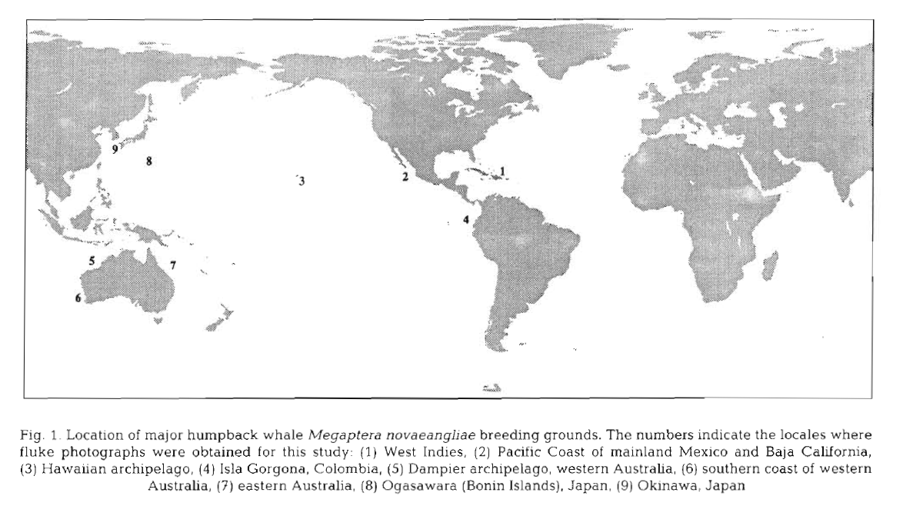
Humpback whales inhabit all oceans of the world and are usually prevalent in coastal waters making annual and seasonal migrations between polar feeding areas and tropical breeding grounds.
The markings on the underside or ventral surface of a humpback whales’ tail flukes are unique and identifiable. In fact, just like humans have individually identifiable fingerprints, the black and white colouration and scarring patterns on humpback whale flukes are their “fingerprints”. Scientists use these markings on the fluke by taking a photograph with a camera, known as photo-ID (photo-Identification) to collect long-term case history information on humpback whales.

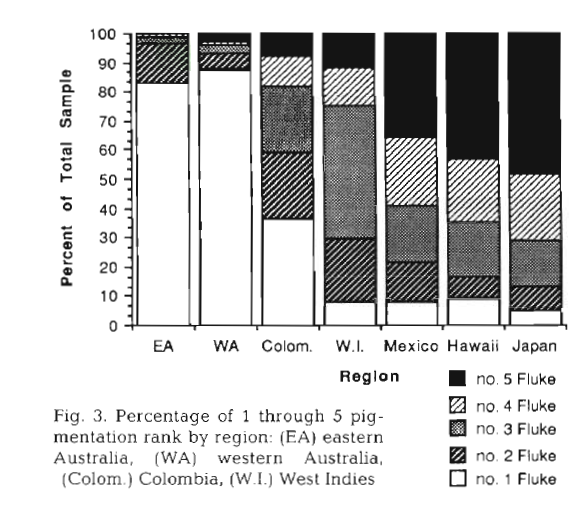
By comparing the proportion of five fluke pigmentation types in humpback whale breeding populations around the world, the lead author Rosenbaum showed that these 7 distinct populations (shown in this figure) were significantly different regarding the proportion of white and black pigmentation. SH humpback whales have predominantly white flukes (on the scale of 1 or 2) and the NH populations possess predominantly black flukes (on the scale of 4 or 5).
The Back Story of the Research – It’s a Fluke!
It was 1991, in our second year on Enderby Island. Curt and I were getting the hang of desert island life. Without mobile phones in those days, we went ashore every Monday to phone home to our parents (assuring them that we were still alive!), send/check the mail at our post office box and purchase our weekly groceries.
On one such day when chatting with our colleague, the late John Bannister, then the Director of the WA Museum, from a payphone at a local hotel/motel, we had an unusual request. The first of many across our career. John had been made aware of global photo-ID study examining the proportion of white and black ventral fluke pigmentation types in 7 different humpback whale breeding areas. Could we accommodate a globe-trotting researcher? The student was interested in humpback whales in Western Australia and with just Curt and I at the rustic “5-star” research station there was ample space available regarding accommodation. No problem. There was indeed all the fresh air you could care to breathe!
The 10 x 20 ft tin shed was bordered on the long sides with two equally sized concrete pads covered by a wooden pergola. The pergola closest to the shed had tin roofing and the other half was open for glorious bedtime stargazing.
Arrangements were made to collect Mr Howard Rosenbaum in Dampier (population 2,000) the small seaside town, on a warm day in September. Our teenage charge, as he turned out, a Fulbright Scholarship awardee, hailed from downtown New York. Our lives could not have been more different. Howard was young, savvy and streetwise but now he was wide-eyed as we hauled his backpack onto Nova, our 5.6m inflatable for the sometimes-choppy, 1 hour or so boat-trip from the boat ramp in Dampier to Home Bay on the NE tip of Enderby Island in the Dampier Archipelago.
The aim of Howards’ research was to collect as many fluke photo-IDs from the Dampier Archipelago with us aboard Nova, for comparison with the 6 other chosen research sites around the world. Our research goals were the same, so Howard’s visit was a perfect fit. The MO was – head offshore everyday (weather-permitting) and look for, locate and work with as many whales as possible each day to produce a photo-ID catalogue that could be compared within years and between years. Regarding the number of resights, Curt and I aimed to use “mark-recapture” analysis across three years of research to produce a population estimate of humpback whales in the Western Australian population (Group IV Breeding Stock).
The weather during a north-west winter was generally quite pleasant with maximums of 21-25-28 C each day and the weather systems moving across Australia from west to east were relatively predictable. We often had 3-4 days of suitable small boating weather (< 15-18 kts) followed by 3-4 days of unsuitable boating conditions. On the bad weather days, we worked half a day and played half a day. The working part of the day entailed developing our b/w film used for photo-ID, selecting photo-ID photos to print at the end of the year for the physical matching catalogue, preparing colour slide presentations and any pressing maintenance of the tin shack. Gathering buckets of saltwater for washing breakfast, lunch and dinner dishes was geared around high tide as well as our personal bathing. The time of high tide and the prevailing wind direction determined when and which beach we bathed at. Swimsuit-clad and dipping in the warm sea with a bottle of saltwater shampoo shared between the crew became the norm, though it must be said – Curt’s salty locks never looked normal!
We even introduced Howard to swimming with dolphins, which one time delightfully swirled around he and I in the clear offshore water. The dolphins danced as they do and then I saw an arching shimmer of small fish. Ooh, I thought. This is a bait ball. Ooh, I thought again, that animal swimming in the middle of the bait ball is not like the others, that is a shark. At that moment Howard spied what I was spying and he swam. He swam, splashing like a dead fish and got the attention of the small passing but then not-passing shark. Our cover was blown and we had to leap back onto Nova. All was fine, but I guess you can take the New Yorker out of New York, but you can’t take New York out of the New Yorker!
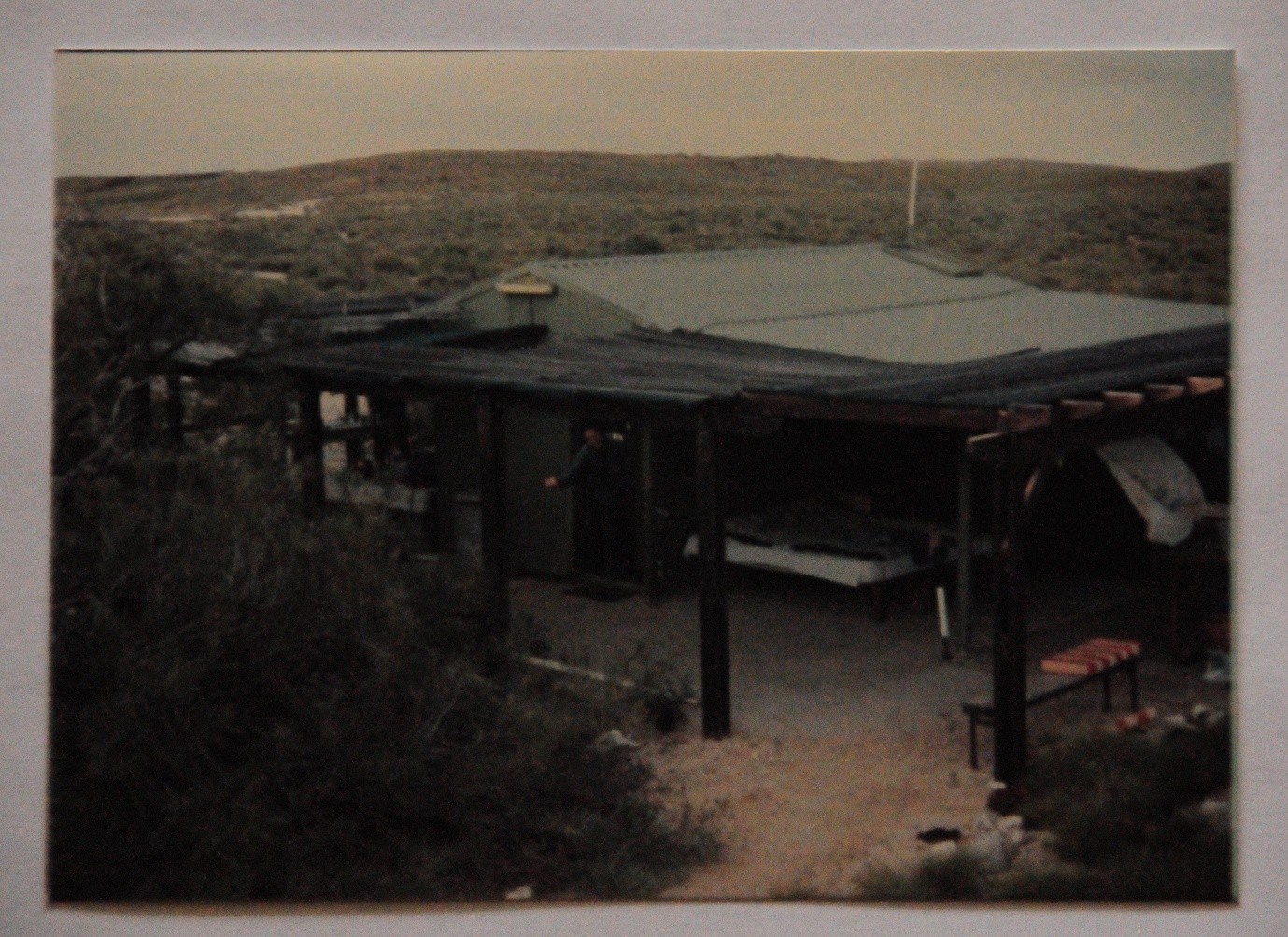 The Shack. A 10 x 20-foot tin shed set on a large concrete pad with an extended wooden and tin roof pergola on 3 sides provided comfortable “basecamp” accommodations during the 5 years of our Dampier Archipelago Humpback Whale Research Project based on Enderby Island. Photo: C. Jenner AM
Given that half of the week was deemed bad weather for boating, on the days that it was calm as the dew dripped from the tin pergola roof in the light winds, yours truly was always eager to get going and, on the water, as early as possible in the morning. Up with the pale pink sunlit sky, I would munch on home-made museli, sipping on piping hot peppermint tea while preparing lunches, filling water bottles, and making final checks on all the research equipment (the datasheet clipboard, the camera case and the hydrophone case) and just was r-e-a-d-y.
Some days when the boys slept ever-so heavily, I had to start the genset which along with the attendant and expected rumble, the power turned on the fluorescent lights overhead their beds! What a taskmaster I was! We just had to get going and indeed, it was special being on the water when it was so deliciously calm. Those days were so infrequent that every moment of calm boating bliss had to be enjoyed!
So, the numbers nicely presented in Howard’s research table are not just numbers. The numbers work and tell a story on their own, but this is not the only story. There was great effort in getting even just one of the columns in that graph showing Howard’s research. Along with the hard work involved, we introduced Howard to desert island life! This encounter now just one of Howard’s rich tapestries of research experiences he has gained during his career since way back then!
But as I always think, would I have had done anything different?
Absolutely not!
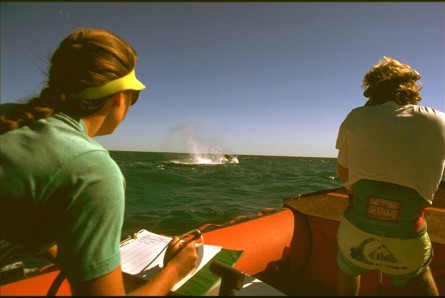 Catching the Photo. Small boat research in the Dampier Archipelago aboard Nova with Micheline (at left) driving and writing notes while Curt (at right) photographs a peduncle-slapping humpback whale. Photo: D. Elford
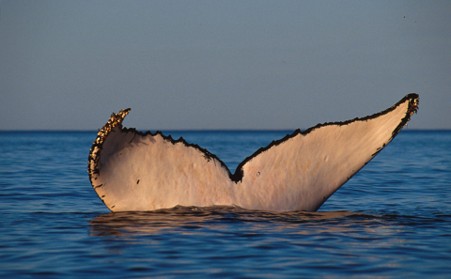 Vanilla Whale. The flukes tell the story of an individual’s life with the gained scars and marks and indeed of its population genetics regarding the predominance of pigmentation types. Photo: C. Jenner AM
 Have We Seen You Before? The patterns on the underside of each humpback whales’ tail flukes are unique and individual like a “fingerprint”. This humpback whales’ flukes can be checked within our CWR Humpback Whale Photo-ID Catalogue as well as on the global Happywhale database. Photo: M. Jenner AM
CWR has been collecting photo-ID data on humpback whales since 1990 and now has amassed a huge amount of data in our CWR Humpback Whale Photo-ID Catalogue. In the last decade, a California-based citizen science project called Happywhale has allowed citizen scientists and whale researchers alike to enter their humpback fluke photographs into a central matching database with super interesting results!
Watch this space for stories of these travelling humpback whales as they voyage wide and far between polar feeding grounds and tropical breeding grounds matched within our CWR Humpback Whale Photo-ID Catalogue and with humpback whale images collected across the Southern Hemisphere!
The world is truly their oyster!
No comments yet.